Interactive guide
Plastic shuttering,explained.
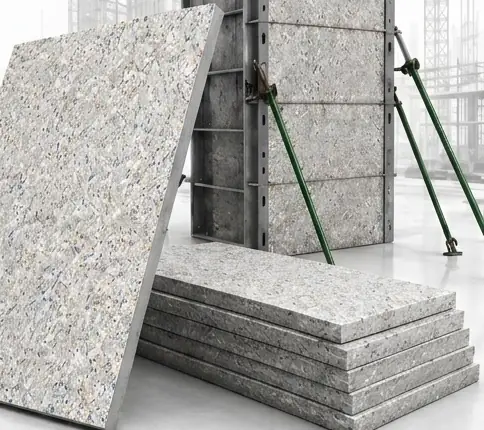
In one paragraph
What is a recycled plastic shuttering sheet?
A recycled plastic shuttering sheet is a flat formwork board made from recycled plastic, used instead of plywood to hold wet concrete in shape for slabs, beams, columns and walls. Because plastic does not absorb water, the sheet does not swell or delaminate, and it is designed to be cleaned and reused across many pours.
It is also called plastic fibre shuttering ply, plastic formwork sheet or sustainable shuttering panel.
From waste to formwork
How recycled plastic sheets are made
The typical recycled-board process, step by step. Ask us to walk you through our own production.[10]
Step 1 of 6
Collect
Used plastic that would otherwise go to landfill or be burnt is collected and brought to the recycling line.
Strength, life and behaviour
Recycled plastic vs plywood
Switch the site conditions to see what changes, then compare the published figures below.
Illustration only, not to scale. Actual performance depends on the product, handling and site conditions.
| Aspect | Plywood shuttering | Recycled plastic sheet |
|---|---|---|
| Typical reuses[2],[3],[4],[5] | About 3–15 pours for ordinary shuttering ply; good film-faced ply up to about 30. | Plastic formwork panels are commonly cited at 50+ pours.Industry figures across different products — actual life depends on handling, cleaning and storage. |
| Water & monsoon[3],[1],[5] | Absorbs moisture, which changes its weight and properties; Indian standard IS 4990 requires boiling-water-proof grade. | Does not absorb water, so it does not swell, rot or delaminate. |
| Termites & fungus[1],[5] | Wood needs preservative treatment; IS 4990 includes a fungal-resistance test. | No wood fibre for fungus or termites to feed on; plastic panels are described as mould-resistant. |
| Stiffness & supports[6],[7] | Stiff veneer construction; published birch formwork ply bending strength ≈ 33–43 N/mm². | Generally more flexible than plywood, so it needs closer supports (one maker specifies 350–400 mm spans).Ask us for the support spacing for our sheet thickness and your load. |
| Heat & sun[7],[3] | Little thermal movement; moisture is the main cause of movement. | Expands in heat — one maker measured ~15 mm growth on a 2.44 m sheet from 15 °C to 57 °C. Leave small gaps and store in shade. |
| Weight[6],[5],[7] | 18 mm birch formwork ply ≈ 12 kg/m². | Depends on construction: hollow-core panels can be ~4 kg/m²; solid recycled sheets ≈ 8–11 kg/m².Ask us for the weight of our sheets in your thickness. |
| End of life[11],[5] | Glued veneers are hard to recycle and usually end up as waste or fuel. | Thermoplastic sheets can be reground and recycled again. |
Industry-typical figures from the sources listed below — they describe the product category, not tests of a specific Gopal Agritech sheet.
Plan your project
How many sheets will you buy?
Set your formwork area, number of pours and expected reuses. Defaults sit inside the published ranges above — change them to match your own experience.
Slab / wall area you shutter at one time.
Adjust to your own site experience.
Ask us for guidance for your application.
With these inputs you would buy
204 fewer sheets
Based on 68 sheets per set (8 × 4 ft ≈ 2.97 m² each). An estimate for planning only — actual reuse depends on handling, cleaning, storage and the job.
Applications
Where and how to use it
Slab decks
Lay sheets on the slab props and runners to form the soffit of RCC slabs in houses, apartments and commercial buildings.
- Keep support spacing close — plastic sheets are more flexible than plywood.
- Butt sheets with a 1–2 mm gap so they can expand in the sun.
- Apply a light, even coat of release agent before each pour.
Get the most pours
Site handling tips
Release agent[12]
Apply a light, even coat before the first use and after each reuse. Heavy coats can cause runs and marks.
Support spacing[7]
Plastic sheets need closer supports than plywood. Confirm spacing for your thickness and slab load before use.
Heat and expansion[7],[12]
Leave 1–2 mm gaps between sheets and oversize fixing holes slightly; plastic grows in strong sun.
Cleaning
Scrape off fresh slurry and wash with water right after striking — concrete does not bond into the plastic.
Storage[7]
Stack flat on level bearers, in shade or under cover. Don't lean sheets for long periods in the sun.
Cutting and fixing
Cut with a fine-tooth saw. Fix with screws or nails per site practice; avoid nailing close to edges.
Environment
How it helps the environment
4.1 milliontonnes / year
plastic waste generated in India (2022-23, CPCB data)[9]
Every sheet made from recycled plastic puts some of it back to work.
Gives plastic waste a working life
Each sheet turns post-use plastic into a durable construction material instead of landfill or open burning.
Less timber for shuttering
Replacing plywood with reusable plastic sheets reduces how much timber-based ply a project buys and discards.
More pours from one set[8]
Longer-lasting formwork means fewer replacement sheets over a project. A 2024 life-cycle study over 50 use cycles ranked plastic formwork as the most sustainable of the options it compared.
Recyclable again[5]
At the end of its life a thermoplastic sheet can be reground and recycled, rather than burnt.
What is a recycled plastic shuttering sheet?
A recycled plastic shuttering sheet is a flat formwork board made from recycled plastic, used instead of plywood to hold wet concrete in shape for slabs, beams, columns and walls. Because plastic does not absorb water, the sheet does not swell or delaminate, and it is designed to be cleaned and reused across many pours.
How many times can a plastic shuttering sheet be reused?
Industry sources commonly cite 50 or more pours for plastic formwork panels, compared with about 3–15 for ordinary shuttering plywood. The real number depends on handling, cleaning, storage and the job, so ask us for guidance for your application.
Is a plastic shuttering sheet stronger than plywood?
Plywood is generally stiffer. Plastic sheets are usually more flexible, so they are used with closer supports. Their advantages are water resistance, no delamination, termite resistance and repeated reuse.
Does it absorb water or swell in the monsoon?
No. Plastic does not absorb water, so the sheet does not swell, rot or delaminate in rain or during wet curing.
Can I use it in hot Indian summers?
Yes, with care. Plastic expands in strong sun, so leave 1–2 mm gaps between sheets, avoid leaving them in direct sun when not in use, and store them flat in shade.
Is it better for the environment?
It turns plastic waste into a long-life product, reduces the timber used for shuttering, lasts for more pours, and can be recycled again at the end of its life.
References
Sources
- [1]BIS — IS 4990 Plywood for concrete shuttering works, product manual — Standard
- [2]Greenply — Shuttering ply rate and price comparison (blog) — Plywood maker
- [3]Doka — Plywood formwork sheets — Formwork maker
- [4]Kim et al., plastic formwork study, Korea Institute of Building Construction conference, 2017 — Research paper
- [5]RENOLIT PLYGOR — plastic formwork panel technical sheet — Manufacturer data
- [6]Metsä Wood — Plywood for concrete formwork, technical data — Manufacturer data
- [7]EKOply recycled plastic sheet — product data and handling — Manufacturer data
- [8]Balasbaneh, Sher & Ibrahim (2024), formwork life-cycle study, Ain Shams Engineering Journal — Research paper
- [9]CPCB plastic waste generation 2022-23 (via Rajya Sabha reply, MoEFCC) — Government data
- [10]Plastic Odyssey — Solutions to make boards with recycled plastics (guide) — Technical guide
- [11]MEVA — plastic formwork facing (blog, plastic-formwork seller) — Formwork maker
- [12]Formply installation guide — release agent, gaps and deflection — Manufacturer data
Want figures for our sheets specifically? Ask for the thickness, weight and support spacing for your job.
Enquiry
Try recycled plastic shuttering on your next pour
Tell us your project, slab area and number of floors. We will suggest the thickness and quantity and send a quotation.