Short answer
Plywood is wood, so it takes up water through cut edges, nail holes and worn film. Wet sheets get heavier, swell and can start to peel. You can protect plywood better (cover it, seal edges, use a proper release agent) or switch to a face that does not absorb water: steel plates, aluminium formwork or plastic shuttering sheets. Steel and aluminium pay off mainly on large, repetitive jobs.
Reviewed by the Gopal Agritech team · Updated 2026-10-19
Why does plywood shuttering swell and peel in the rains?
Wood is hygroscopic: it picks up moisture from wet surroundings and swells, then shrinks as it dries. Repeated swelling and shrinking can warp, check and split wood products.
Shuttering plywood made to IS 4990 is BWP-bonded and preservative treated, and the standard expects it to handle alternate wetting and drying. But concreting is a wet job. The sheet faces cement slurry, curing water and rain. Water gets in wherever the protective film or paint is broken. IS 4990 notes that the mass of wet plywood may rise by 30% or more, so soaked sheets are also harder to lift and handle.
A study of formwork boards makes the same point: faces and edges are coated to keep moisture out, and a failed coating can flake off when the form is stripped.
- Water enters through cut edges, nail and tie holes, and scratches in the film face.
- Sheets left on wet ground or uncovered in rain soak up water between uses.
- Swollen sheets stop fitting tightly, so slurry can leak through joints.
Which shuttering materials handle wet weather better?
IS 14687, the Indian guideline for falsework, allows timber, plywood, steel, aluminium and plastics such as PVC, HDPE and polypropylene. Each has a place. The table compares them for monsoon conditions.
| Material | Water behaviour | Weight and handling | Reuse | Upfront cost | Best for |
|---|---|---|---|---|---|
| Film-faced / shuttering plywood (IS 4990) | Film face resists water; wood core swells if edges, holes or film are damaged. Wet sheets can be 30% heavier. | About 7.8 kg per sq m at 12 mm when dry. Easy to cut, nail and shape on site. | Many times, but only with careful handling, oiling and storage. | Low per sheet | Small and medium jobs, odd shapes, short runs |
| Steel plates | Does not absorb water, shrink or warp. Must be cleaned and painted or oiled to control rust. | Heavy: steel is about 12 times denser than plywood. Limited sizes and fixing options. | Many times | High unless used at large scale | Big projects with repeated use, circular columns, flat slabs |
| Aluminium formwork system | Does not absorb water; surface is easy to clean. | Light and easy to handle; panels are designed for one building plan. | Designed for many repetitions; at least 100 repetitions desirable for economy (BMTPC). | High initial investment; about 3 months lead time | Mass housing with many identical floors or units |
| Plastic / recycled plastic shuttering sheets | Plastic does not soak up water like wood, so it does not swell or delaminate. | Sheet weight depends on thickness; ask your supplier. Can be nailed and re-fixed. | Can be reused many times if the face is not scoured during vibration. | Quoted per size; compare cost per use | Slabs, beams, columns, walls and foundations on regular sites |
When are steel or aluminium the better choice?
Be honest about your project size. Steel and aluminium win when the same form is used again and again.
The Government of India's Building Materials and Technology Promotion Council (BMTPC) says aluminium formwork needs a high initial investment and may not be economical for projects below about 500 units. It also notes little saving on single-storey work, a lead time of about three months for design and manufacture, and that the building cannot easily be altered later. For large housing schemes with typical floors, it can give a slab cycle of about four days.
Steel formwork is commonly used on big projects where forms are reused many times, and suits circular columns and flat slabs. It does not absorb water. Its limits are fixed sizes, limited ways to fix it, and heat: IS 4990 notes that sun heat passes through metal sheeting much more than through plywood.
For a house, a small building or many odd shapes, site-built formwork with plywood or plastic sheets is more flexible and practical.
Where do plastic shuttering sheets fit?
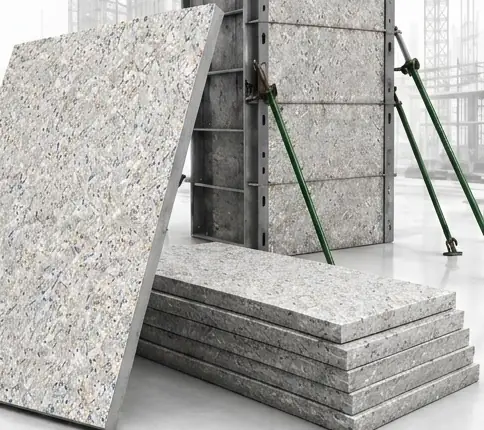
Plastic sheets sit between plywood and metal systems. They are used like plywood sheets, nailed and fixed to a timber or steel frame, but they do not take up water. That makes them useful where sheets stay wet for weeks or cannot always be stored under cover.
A university formwork lecture notes that, like steel, plastic formwork can be reused many times as long as the surface is not scoured while the concrete is vibrated. Ask your supplier for sheet size, thickness and weight, and compare cost per use, not per sheet.
- Good fit: slabs, beams, columns, walls and footings on houses and mid-size buildings.
- Still needed: a proper frame, props and bracing designed for the concrete load.
- Still needed: a release agent and cleaning after each pour.
- Not a replacement for a full aluminium system on a large, repetitive housing project.
How do I make shuttering last through the monsoon?
These steps come mainly from IS 4990 (Annex E), IS 14687 and IS 456. Most apply to every material.
- 1Store sheets flat on a level, raised base in a dry, covered place with air around them. Cover the top of the stack and weigh it down.
- 2Lift sheets; do not drag them. Dragging scratches the film face and lets water in.
- 3Seal every cut edge and drilled hole with a sealant paint before use, and reseal after any new cut.
- 4Before each pour, remove chips, shavings and sawdust from inside the forms.
- 5Apply a thin, even coat of a proper release agent before each use. Keep it off the reinforcement. Do not use waste engine oil.
- 6For shuttering plywood, re-coat with mould oil after 3–4 uses and after long storage.
- 7Clean off concrete and mortar after every use. Clean, repair and periodically paint metal forms, and oil threaded parts.
- 8If sheets will be stored for a long time, dry them first by stacking on spacers with free air flow.
- 9Check sheets between uses. Remove any with rot, splits, heavy distortion or separating layers.
How do I choose for my site?
- Hundreds of identical floors or units: get a quote for an aluminium system and check the BMTPC economics.
- Many repeated circular columns or flat slabs on a big project: steel forms can make sense.
- Individual houses and small buildings in heavy rain areas: plastic shuttering sheets avoid the swelling problem.
- Complex one-off shapes: plywood is easiest to cut, but seal every cut edge.
- Whatever you choose, plan reuse early. IS 14687 asks for a reuse plan with minimum cutting and wastage.
Where we can help
How Gopal Agritech can help
Gopal Agritech in Surat makes a Recycled Plastic Shuttering Sheet, also called plastic fibre shuttering ply. It does not absorb water, so it does not swell or delaminate like plywood. It is termite resistant, and it can be nailed, fixed and re-fixed for slab, beam, column, wall and foundation work. Sizes, thickness and price are given on quotation, with delivery across India.