Short answer
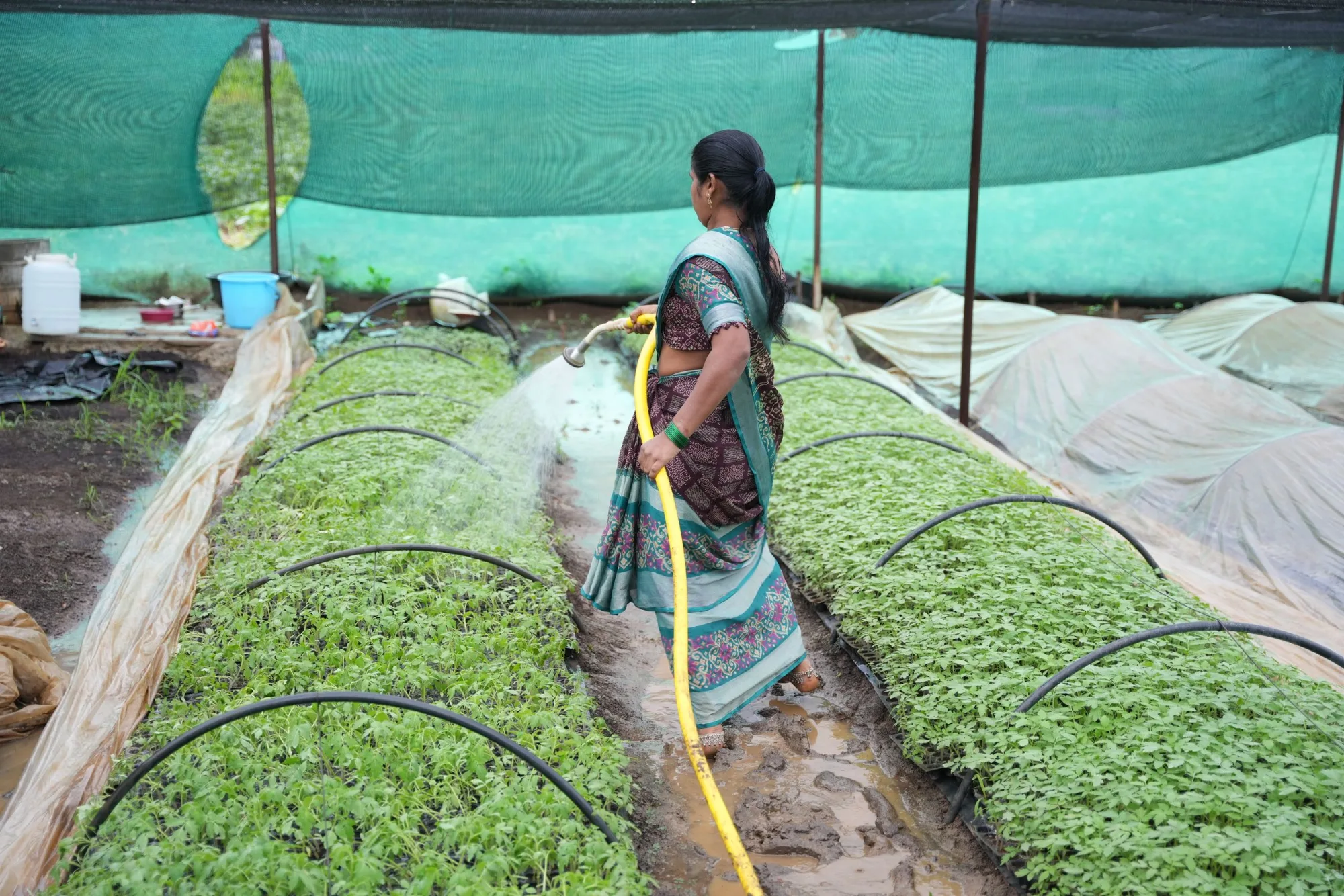
Most vegetables and nursery seedlings in India do best under 35-50% shade. TNAU uses 50% for protray nurseries and found 35% best for capsicum. ICAR trials found 50% best for tomato and leafy coriander. Shade-loving ornamentals need much more: TNAU recommends about 75% for anthurium and Dendrobium orchids. Gerbera and cut foliage do well at about 50%.
Reviewed by the Gopal Agritech team · Updated 2026-10-19
What does the shade percentage on a net mean?
The shade percentage tells you roughly how much sunlight the net holds back. A 50% net lets through about half the light. A 90% net lets through very little. Shade nets are sold in many grades. Vikaspedia (Government of India) lists 25%, 30%, 35%, 50%, 60%, 75% and 90%.
More shade is not always better. Fruiting vegetables need light to set fruit. Too much shade gives tall, weak plants and lower yield. Shade-loving ornamentals such as anthurium are the opposite. They scorch in strong sun and need a dark net.
Colour matters too. An ICAR article from Banda University of Agriculture and Technology says black nets cut temperature the most, compared with green, white or silver.
Which shade % suits which crop?
The table below only lists crops for which we found a research or extension source. Figures are for Indian conditions. Your local climate, season and variety can shift the best choice by one grade.
| Crop or use | Shade % in the source | Source |
|---|---|---|
| Vegetable nursery seedlings in protrays (capsicum, brinjal) | 50% shade net on top; 40/50 mesh insect-proof net on the sides | TNAU Agritech Portal |
| Capsicum (sweet pepper) | 35% gave the best results in a two-season trial; 35% beat 50% and open field | TNAU study, Killikulam (Asian Journal of Horticulture, 2008) |
| Capsicum in a net house (Karnataka design) | Fixed 50% white net, plus a movable 35% net used at midday from February to June | Vikaspedia package of practices |
| Tomato (rainy season) | 50% gave the highest yield; 75% green gave the lowest | ICAR-CIAE Bhopal (Emirates J. Food & Agriculture, 2023) |
| Leafy coriander (off season) | 50% best, then 35%; open field far lower | Dr YSR Horticultural University, Guntur |
| Leafy and root vegetables in general | 40-75% depending on the crop | ICAR Indian Horticulture (BUAT, Banda) |
| Gerbera | 50% | Kerala Agricultural University |
| Cordyline (cut foliage) | 50% best out of 35%, 50%, 75% and 90% | ICAR-IARI New Delhi (IJAS, 2015) |
| Anthurium | 70-80%; grown in a 75% shade net house | TNAU Agritech Portal |
| Dendrobium orchid | 75% green shade net house | TNAU Agritech Portal |
Why do vegetables need less shade than orchids?
Vegetables like tomato and capsicum are sun crops. In Indian summers the sun is often too strong, so a light net helps. But a dark net cuts too much light. In the ICAR-CIAE tomato trial, the 75% green net gave the lowest yield of all the nets tested. In the TNAU capsicum trial, 35% did better than 50%.
Anthurium and orchids grow naturally under tree cover. TNAU gives a light level of 1,500-2,000 foot-candles for both crops. That is why they need a 70-80% net. Leafy greens sit in the middle. They like some shade in hot months, and the coriander trial found 50% gave the most leaf.
Should I change the shade with the season?
Yes, if you can. A single fixed net is a compromise. Many growers use two layers.
- Movable second layer: The Vikaspedia capsicum design adds a movable 35% net over the fixed 50% net. It is used on hot summer middays, mainly from February to June, and whenever sunlight is strong between 11 am and 3 pm.
- Shade on a polyhouse roof: The BUAT Banda article advises covering polyhouse roofs with shade net (preferably black) in the hottest months, May to July. Leave a gap between the net and the roof so air can move.
- Darker roof, lighter sides: A shade house design from Orissa University of Agriculture and Technology, published on Vikaspedia, uses 50-75% net on the roof and 30% net on the sides.
When is a shade net not the right answer?
A shade net cuts light and heat. It does not keep rain out. For some crops a polyhouse works better.
Cucumber is a clear example. A two-year ICAR-CAZRI trial in Jodhpur found cucumber yield in a naturally ventilated polyhouse was 121% higher than in a 50% green shade screenhouse. For capsicum, Vikaspedia notes that polyhouse yields are normally 15-20% higher than net house yields, because rain is kept out and leaf diseases are easier to control.
If you grow these crops through the monsoon or want top yields, compare both options before you build.
How do I choose the right net for my farm?
- 1Write down the crop and the months you will grow it.
- 2Find the crop in the table above and note the shade range.
- 3If you grow through April to June in Gujarat or Maharashtra, plan for a movable extra layer instead of one dark net.
- 4For fruiting vegetables, do not go darker than the source suggests. Too much shade lowers yield.
- 5For anthurium and orchids, use a 75% net, as TNAU recommends.
- 6Ask your local Krishi Vigyan Kendra or horticulture officer if your variety needs a different level.
Where we can help
How Gopal Agritech can help
Gopal Agritech makes green HDPE tape shade net in 50%, 75% and 90% shade as standard, with 35% on request. That covers the range used for nurseries, vegetables, gerbera, anthurium and orchids in the table above. Rolls are 50 m long, in widths from 1 m to 6 m, with 2% or 4% UV stabilisation.