Short answer
Plywood near the sink swells because wood absorbs water, and damp wood attracts termites. If you stay with plywood, choose BWP (marine) grade, not MR. For cabinets that do not swell, look at PVC foam board, WPC board, recycled plastic sheets or stainless steel. Plastic and steel are not termite food, but fix leaks and termite entry points too, because no board alone makes a kitchen termite-proof.
Reviewed by the Gopal Agritech team · Updated 2026-10-19
Why does kitchen plywood swell and get termites?
Wood takes up moisture from its surroundings and swells, then shrinks as it dries. Repeated swelling and shrinking can warp and split wood products and loosen joints. Under a kitchen sink, plywood faces leaks from pipes and waste lines, water splashed during washing, and wet mopping at floor level.
Termites add a second problem. The Indian code for anti-termite treatment (IS 6313) explains that termites feed on cellulose, which is what wood is made of. The common subterranean termites need moisture, enter from the ground and travel up through floors in covered mud tunnels. The code names damp places, such as bathrooms and spots with leaky pipes or drains, as likely sites of attack. A wet sink cabinet made of wood ticks both boxes.
- Swollen or bubbled laminate at the bottom edge of the cabinet.
- Hinges and screws that no longer hold.
- Mud tubes on walls or the cabinet back. New tubes are moist and firm; old ones are brittle.
- Woodwork that sounds hollow when tapped.
Is MR, BWR or BWP plywood good enough?
The grade names come from the glue test, not from the wood itself.
Under IS 303, MR (moisture resistant) plywood is tested in water at 60 °C for 3-hour cycles. BWR plywood is tested in boiling water for 8-hour cycles. Marine plywood under IS 710 uses BWP-type glue, must survive 72 hours of boiling, and is pressure-treated with a preservative.
A stronger glue means the layers are less likely to separate when wet. But the veneers are still wood, so they can still swell if water sits on them, and they are still termite food. An Indian home-design guide suggests MR for dry rooms only, BWR for kitchens, and marine ply as the most suitable for wet areas, at a higher price.
How do the common kitchen options compare?
| Material | Water | Termites | Screw holding | Finish options | Cost level |
|---|---|---|---|---|---|
| MR plywood (IS 303) | Glue tested only in 60 °C water. Meant for dry areas. | Wood is termite food; at risk when damp. | Good while dry; loosens as wood swells and shrinks. | Laminate, veneer, paint | Lowest of the plywood grades |
| BWR plywood (IS 303) | Glue passes boiling-water cycles; wood still swells if soaked. | Wood is termite food; at risk when damp. | Good while dry; loosens as wood swells and shrinks. | Laminate, veneer, paint | Close to MR |
| BWP / marine plywood (IS 710) | Toughest glue test (72 h boiling); wood still absorbs water. | Preservative-treated, which helps; still wood. | Good while dry; loosens as wood swells and shrinks. | Laminate, veneer, paint | Highest of the plywood grades |
| PVC foam board | PVC itself takes up very little water (under 0.2% in a standard test). | Not termite food. | Depends on board density; ask for test data. | Ask the supplier; laminate or paint | Get quotes; varies with thickness and density |
| WPC board | Low, but the wood flour inside does take up water. | Better than solid wood; untreated WPC still lost weight in a field test. | Depends on the board; ask for test data. | Ask the supplier | Get quotes |
| Recycled plastic sheets / ply | Gopal Agritech's sheet does not absorb water, so it does not swell. | Termite resistant. | Can be nailed, fixed and re-fixed. | Ask the supplier | Given on quotation |
| Stainless steel / aluminium modular | Metal does not absorb water. Stainless grade affects rust resistance. | Not termite food. | Metal fixings; no wood joints to swell. | Metal finish; ask for panel options | Get quotes; depends on grade and gauge |
What are the trade-offs of plastic boards?
- Heat: solid PVC starts to soften at roughly 75–83 °C (Vicat softening point). Keep PVC boards away from direct burner heat and ask the supplier for the heat rating of any plastic board placed beside a hob.
- WPC is a mix of wood flour and plastic. Research shows the wood part is mainly responsible for water uptake and swelling. More wood usually means more water uptake.
- WPC and termites: in a 30-month field test in Indonesia, untreated WPC lost 11–23% of its weight to termites, while solid pine was completely destroyed. Treated WPC did better. So WPC is far better than wood, but not immune.
- Termites are not stopped by the cabinet alone. IS 6313 notes that termites also damage non-food materials while searching for food. Fix the building's termite problem at the source.
- Screw holding and finishes vary a lot between boards. Ask for a sample and fix a hinge before you order.
When is stainless steel the better choice?
Stainless steel does not absorb water and is not termite food, so it suits wet areas well. The grade matters. An Australian stainless steel industry body notes that most 200-series grades resist corrosion less than grade 304 because they contain less chromium. Lower-chromium 200-series grades are fine for indoor items that are washed and dried, but grade 304 is the safer choice for a sink area that stays wet. Ask for the grade in writing on the quotation.
How do I keep a kitchen cabinet dry and termite-free?
- 1Fix leaks at the sink, waste pipe and water purifier connections first. Leaky pipes and drains are named in IS 6313 as likely sites of termite attack.
- 2Choose a non-absorbent material, or BWP plywood at the least, for the sink base and bottom panels.
- 3Inspect with a bright torch. Probe suspect woodwork with a sharp knife and tap it to hear if it sounds hollow.
- 4Look for mud tubes on walls and behind cabinets. Do not break them during inspection.
- 5If you find termites in one room, inspect the whole house, including upper floors.
- 6Get a professional anti-termite treatment for existing buildings, as set out in IS 6313 Part 3.
Where we can help
How Gopal Agritech can help
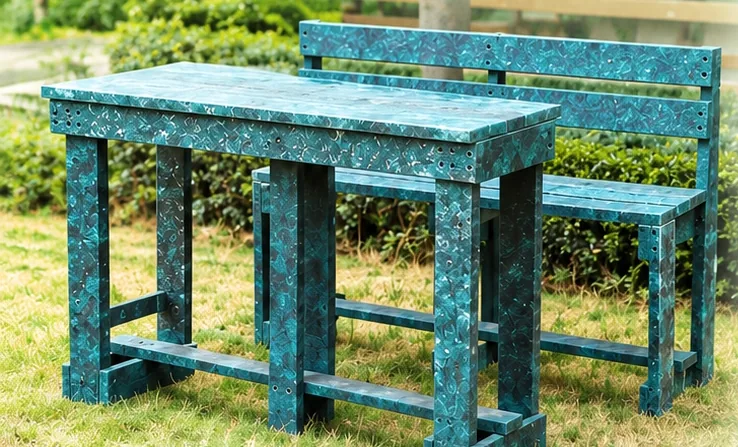
Gopal Agritech makes recycled plastic ply, the same material as its shuttering sheet, and it is used for kitchen platforms and cabinets, furniture, storage units, wall panels and partitions. It does not absorb water, so it does not swell or delaminate like plywood, it is termite resistant, and it can be nailed, fixed and re-fixed. Sizes, thickness and price are given on quotation.