Short answer
Build a shade net house if you need low-cost protection from strong sun and heat, for nurseries, leafy greens or shade-loving flowers. Build a polyhouse if you grow high-value crops like cucumber or coloured capsicum through the monsoon and winter. It keeps rain out and gives higher yields. But it costs more, and it needs shading and good ventilation in summer.
Reviewed by the Gopal Agritech team · Updated 2026-10-19
What is the real difference?
A shade net house is a frame covered with agro shade net. Light, moisture and air pass through the gaps in the net, as Vikaspedia describes it. It cuts sunlight and heat, but rain still gets in.
A polyhouse is a frame covered with UV-stabilised plastic film, often 200 micron thick. Rain cannot get in. TNAU notes that in a low-cost polyhouse the climate is still not fully controlled. A naturally ventilated polyhouse relies on roof and side vents. A fan-and-pad polyhouse adds active cooling at a higher cost.
How do they compare side by side?
| Point | Shade net house | Naturally ventilated polyhouse |
|---|---|---|
| Covering | Agro shade net, 25-90% shade (Vikaspedia) | UV-stabilised polyethylene film, 200 micron (TNAU) |
| Cost level (Gujarat unit cost, tubular) | ₹710 per sq m | ₹1,000-1,200 per sq m, depending on size; fan-and-pad ₹1,500-1,800 per sq m |
| Rain and monsoon | Rain passes through | Rain kept out, so leaf diseases are easier to control (Vikaspedia) |
| Peak summer | Advised for harsh summer months (ICAR, BUAT Banda) | Gets hot; shade net on the roof is advised in May-July (ICAR, BUAT Banda) |
| Ventilation and humidity | Air passes through the net | Depends on vents; relative humidity ran 17 points higher than in an insect-net house in an ICAR-CAZRI study |
| Crops suited (BUAT Banda) | Leafy and root vegetables (April-August), cucumber in some seasons | Cucumber, tomato, capsicum (August-April) |
| Yield example | Base | Capsicum 15-20% higher (Vikaspedia); cucumber 121% higher than a 50% shade screenhouse (ICAR-CAZRI) |
| Upkeep | Net lasts 3-5 years; steel frame 20-25 years with anti-rust care (Vikaspedia) | Strong winds can damage the plastic sheet and raise upkeep cost (Vikaspedia) |
When is a polyhouse the better choice?
Be honest about your crop and season. A polyhouse often pays back better in these cases:
- You grow cucumber. In a two-year ICAR-CAZRI trial in Jodhpur, cucumber in a naturally ventilated polyhouse yielded 3.50 kg per plant, against 1.58 kg in a 50% green shade screenhouse.
- You grow coloured capsicum for hotels and city markets. Vikaspedia notes polyhouse capsicum yields are normally 15-20% higher than in a net house.
- Your crop must grow through heavy rain. A polyhouse stops rain entry, which helps control leaf diseases.
- You want a long crop of 7-10 months. ICAR's BUAT Banda article lists polyhouses for crops from August to April.
When is a shade net house the better choice?
A shade net house is simpler and cheaper. It is often the right first step.
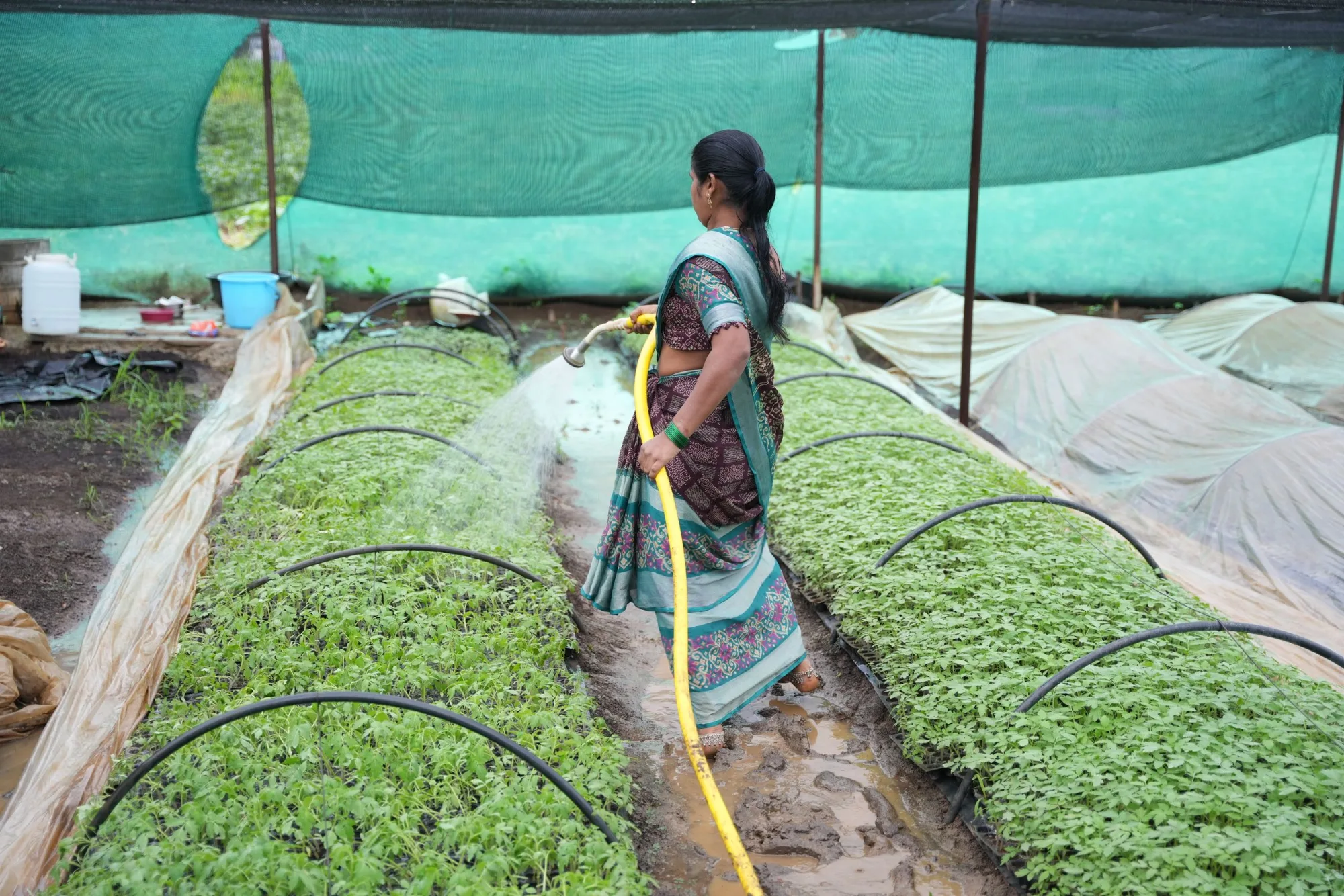
- Nurseries and seedlings. TNAU raises protray vegetable seedlings under 50% shade net, and Vikaspedia lists fruit and vegetable nurseries and hardening of tissue culture plants as key uses.
- Leafy greens in summer. BUAT Banda prefers shade nets for leafy vegetables such as beet leaf and coriander.
- Shade-loving flowers and foliage. TNAU recommends 75% shade net houses for anthurium and Dendrobium orchids.
- Hot, dry summers. BUAT Banda advises large-scale use of shade net houses in harsh summer months.
- A limited budget. Gujarat's unit cost for a tubular shade net house is ₹710 per sq m, well below a polyhouse.
Can I combine the two?
Yes, and many growers do. A polyhouse still needs shade net in summer. The Vikaspedia capsicum polyhouse has retractable shade nets at about 11 feet height, inside the structure. BUAT Banda advises covering polyhouse roofs with shade net in May to July, with a gap between net and roof for air.
You can also start with a shade net house and add a rain roof later, if your frame is designed for it. Ask your fabricator before you build.
Do subsidies cover both?
Yes. Gujarat's horticulture schemes, applied for on i-Khedut, list both. For tubular structures, shade net houses have a unit cost of ₹710 per sq m. Naturally ventilated polyhouses range from ₹1,000 to ₹1,200 per sq m depending on size. Assistance is 50% of the cost. Some schemes add state top-ups. The pages show a limit of 2,500 sq m per beneficiary, and a 2025 Union Ministry letter raised the MIDH limit to 4,000 sq m. Check the current portal, because rates change.
How do I decide?
- 1List your crops and the months you will grow them.
- 2If the crop is cucumber, coloured capsicum or a long-season tomato, price a polyhouse first.
- 3If it is a nursery, leafy greens or anthurium and orchids, start with a shade net house.
- 4Check your budget against the Gujarat unit costs, and ask about subsidy at your district horticulture office.
- 5Plan summer shading either way: a shade net house, or shade net over the polyhouse.
Where we can help
How Gopal Agritech can help
Gopal Agritech makes green HDPE tape shade net in 50%, 75% and 90% shade, with 35% on request, in 50 m rolls up to 6 m wide. It suits both a full shade net house and summer shading inside or over a polyhouse. For polyhouse film, ask a specialist supplier.